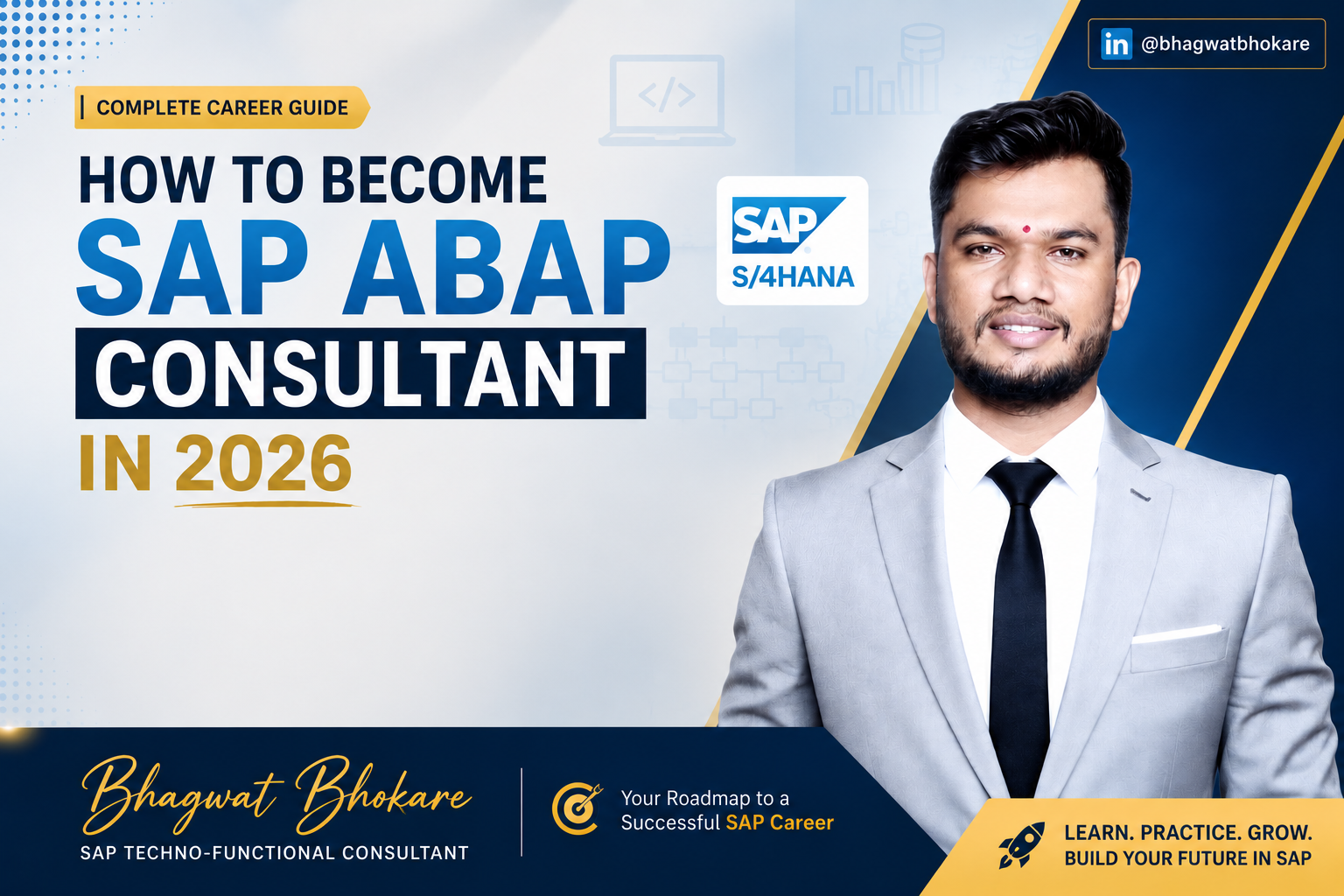
SAP is one of the world’s leading Enterprise Resource Planning (ERP) systems used by thousands of organizations to manage their business operations. Behind every successful SAP implementation, there are technical professionals who customize, develop, and enhance SAP solutions according to business requirements.
One of the most in-demand technical careers in the SAP ecosystem is SAP ABAP Consultant.
If you are a student, fresher, software developer, or IT professional looking to build a rewarding career in SAP, this guide will help you understand everything you need to know before starting your journey as an SAP ABAP Consultant.
Table of Contents
- What is SAP?
- What is SAP ABAP?
- Who is an SAP ABAP Consultant?
- Why Choose SAP ABAP as a Career?
- Roles and Responsibilities of an SAP ABAP Consultant
- Skills Required to Become an SAP ABAP Consultant
- Educational Qualification Required
- SAP ABAP Career Roadmap for Beginners
- SAP ABAP Topics You Must Learn
- SAP ABAP on HANA and S/4HANA
- SAP ABAP Certification
- Real-Time Project Experience
- SAP ABAP Interview Preparation
- SAP ABAP Salary in India
- Career Growth Opportunities
- Common Mistakes Beginners Make
- Learning Resources for SAP ABAP
- Frequently Asked Questions (FAQs)
- Final Thoughts
1. What is SAP?
SAP (Systems, Applications, and Products in Data Processing) is an ERP software that helps organizations manage finance, sales, procurement, manufacturing, human resources, supply chain, and other business processes through a single integrated platform.
Companies such as Tata Motors, Reliance, Infosys, TCS, Wipro, Accenture, IBM, and thousands of multinational organizations use SAP solutions.
2. What is SAP ABAP?
ABAP (Advanced Business Application Programming) is SAP’s proprietary programming language used to develop and customize SAP applications.
ABAP allows developers to:
- Create reports
- Develop interfaces
- Design forms
- Build enhancements
- Create workflows
- Develop APIs
- Customize SAP standard functionality
ABAP acts as the technical backbone of SAP systems.
3. Who is an SAP ABAP Consultant?
An SAP ABAP Consultant is responsible for designing, developing, testing, and maintaining SAP applications using ABAP programming.
They work closely with functional consultants such as:
- SAP FICO Consultants
- SAP MM Consultants
- SAP SD Consultants
- SAP PP Consultants
- SAP HCM Consultants
The functional team provides business requirements, and the ABAP consultant develops the technical solution.
4. Why Choose SAP ABAP as a Career?
1. High Demand
SAP implementations continue to grow globally, creating continuous demand for ABAP professionals.
2. Excellent Salary Packages
SAP consultants generally receive higher salaries compared to many traditional software roles.
3. Global Opportunities
SAP professionals work in:
- India
- USA
- Germany
- Canada
- Australia
- Middle East
- Singapore
4. Long-Term Career Stability
SAP is deeply embedded in large enterprises, making ABAP skills valuable for many years.
5. Multiple Career Paths
You can grow into:
- Senior ABAP Consultant
- Technical Lead
- SAP Architect
- SAP Technical Manager
- SAP Integration Consultant
- SAP BTP Developer
5. Roles and Responsibilities of an SAP ABAP Consultant
An SAP ABAP Consultant performs activities such as:
Development
- Reports
- Dialog Programs
- Enhancements
- Interfaces
- Forms
Support Activities
- Bug fixing
- Performance tuning
- User issue resolution
Implementation Activities
- Requirement gathering
- Technical design
- Development
- Unit testing
- Deployment
Documentation
- Technical Specifications
- Test Cases
6. Skills Required to Become an SAP ABAP Consultant
Technical Skills
Core ABAP
- Data Types
- Internal Tables
- Structures
- Work Areas
- Modularization Techniques
Reports
- Classical Reports
- Interactive Reports
- ALV Reports
Data Dictionary
- Tables
- Views
- Domains
- Data Elements
- Search Helps
Dialog Programming
- Screens
- PBO
- PAI
- Module Pools
Forms
- SAPScript
- SmartForms
- Adobe Forms
Interfaces
- BDC
- BAPI
- RFC
- IDoc
Enhancements
- User Exits
- Customer Exits
- BADI
- Enhancement Framework
Object-Oriented ABAP
- Classes
- Objects
- Inheritance
- Polymorphism
Performance Optimization
- SQL Optimization
- Runtime Analysis
- Code Inspector
Soft Skills Required
Apart from technical knowledge, you should develop:
- Communication Skills
- Problem-Solving Skills
- Analytical Thinking
- Documentation Skills
- Team Collaboration
- Client Handling Skills
These skills are critical during project implementations.
7. Educational Qualification Required
There is no mandatory degree requirement for SAP ABAP.
However, the following backgrounds are beneficial:
- B.E./B.Tech
- BCA
- MCA
- B.Sc. Computer Science
- M.Sc. IT
- Diploma in Computer Engineering
Even professionals from non-IT backgrounds can learn ABAP with proper training and practice.
8. SAP ABAP Career Roadmap for Beginners
Step 1: Understand SAP Basics
Learn:
- What is ERP?
- What is SAP?
- SAP Architecture
- SAP Modules
- SAP Landscape
Step 2: Learn Programming Fundamentals
Understand:
- Variables
- Loops
- Conditions
- Functions
- Database Concepts
Programming fundamentals make ABAP easier to learn.
Step 3: Learn Core ABAP
Focus on:
- Data Dictionary
- Internal Tables
- Reports
- Modularization
- Open SQL
Practice daily.
Step 4: Learn Advanced ABAP
Cover:
- ALV Reports
- SmartForms
- Adobe Forms
- Enhancements
- Interfaces
Step 5: Learn ABAP on HANA
Important topics:
- CDS Views
- AMDP
- HANA Database Concepts
- Code Pushdown Techniques
Step 6: Learn S/4HANA ABAP
Modern SAP projects require:
- CDS Views
- OData
- RAP Model
- Fiori Integration
- RESTful Programming
Step 7: Work on Real-Time Scenarios
Develop projects such as:
- Employee Management System
- Purchase Order Report
- Sales Dashboard
- Vendor Payment Report
- Inventory Tracking Report
9. SAP ABAP Topics You Must Learn
Beginner Level
- Data Dictionary
- Reports
- Internal Tables
- Open SQL
- Modularization
Intermediate Level
- ALV Reports
- SmartForms
- SAPScript
- Module Pool Programming
- Enhancements
- File Handling
Advanced Level
- BAPI
- BDC
- RFC
- IDoc
- Workflow
- CDS Views
- AMDP
- OData
- Fiori Integration
- RAP Model
10. SAP ABAP on HANA and S/4HANA
Modern organizations are migrating from ECC to SAP S/4HANA.
Therefore, beginners should focus on:
CDS Views
Used for high-performance data modeling.
AMDP
Database procedures executed directly on HANA.
OData Services
Used to connect SAP backend with Fiori applications.
RAP Model
SAP’s latest development framework.
These skills significantly improve job opportunities.
11. Should You Get SAP ABAP Certification?
Certification is not mandatory but can help freshers.
Benefits include:
- Improved resume visibility
- Better interview opportunities
- Validation of skills
- Increased confidence
However, practical skills and project experience remain more important than certification alone.
WhatsApp me to book your global Certification Attempts: +91 9623241316
12. How to Gain Real-Time Project Experience
Practice Server Access
DM me for Practise server – WhatsApp link
Work on:
- Report Development
- SmartForms
- ALV Reports
- Enhancements
Build Portfolio Projects
Create:
- Vendor Aging Report
- Customer Ledger Report
- Purchase Analysis Dashboard
- Material Stock Report
Internship Programs
Look for SAP internship opportunities to gain industry exposure.
13. SAP ABAP Interview Preparation
SAP ABAP Realtime Interview Q&A PDF – Link
Prepare:
Technical Questions
- Internal Tables
- Joins
- CDS Views
- ALV Reports
- Enhancements
- BAPI
- IDoc
Practical Questions
- Real-time scenarios
- Performance tuning
- Error handling
Project Questions
Be prepared to explain every project listed on your resume.
14. SAP ABAP Salary in India
Approximate salary ranges:
| Experience | Salary Range |
| Fresher | ₹3 LPA – ₹6 LPA |
| 2-4 Years | ₹6 LPA – ₹12 LPA |
| 5-8 Years | ₹12 LPA – ₹20 LPA |
| 8+ Years | ₹20 LPA – ₹35 LPA+ |
Salaries vary based on location, company, skills, and project experience.
15. Career Growth Opportunities
A typical SAP ABAP career path:
SAP ABAP Trainee
↓
SAP ABAP Consultant
↓
Senior ABAP Consultant
↓
Technical Lead
↓
Solution Architect
↓
SAP Technical Manager
↓
Enterprise Architect
16. Common Mistakes Beginners Make
Avoid these mistakes:
- Learning only theory
- Ignoring S/4HANA concepts
- Not practicing coding daily
- Copy-pasting code without understanding
- Focusing only on certification
- Not learning business processes
- Poor communication skills
17. Best Learning Resources for SAP ABAP
Documentation
- SAP Help Portal
- SAP Learning Resources
Practice
- SAP Practice Servers
- Real-Time Scenarios
Community
- SAP Community Forums
- LinkedIn SAP Groups
Training
- SAP ABAP Training Programs
- S/4HANA ABAP Courses
18. Frequently Asked Questions (FAQs)
Is SAP ABAP a good career in 2026?
Yes. SAP ABAP remains one of the most in-demand technical SAP skills, especially with S/4HANA migration projects increasing worldwide.
Can non-IT students learn SAP ABAP?
Yes. Anyone with dedication and basic computer knowledge can learn SAP ABAP.
Is coding mandatory for SAP ABAP?
Yes. SAP ABAP is a programming-based role and requires coding skills.
Which is better: SAP ABAP or Full Stack Development?
Both have excellent opportunities. SAP ABAP is ideal for those interested in enterprise applications and ERP systems.
How long does it take to learn SAP ABAP?
Most beginners can learn SAP ABAP fundamentals in 3–6 months with regular practice.
19. Final Thoughts
SAP ABAP is one of the most stable and rewarding technical careers in the SAP ecosystem. With organizations rapidly adopting SAP S/4HANA, the demand for skilled ABAP developers continues to rise.
If you are serious about building a career in SAP, focus on strong ABAP fundamentals, real-time project practice, S/4HANA technologies, and continuous learning. Rather than chasing certifications alone, invest time in practical development skills and business process understanding.
Start with the basics, practice consistently, work on real-world scenarios, and build a strong portfolio. With dedication and the right roadmap, you can successfully launch your career as an SAP ABAP Consultant in 2026 and beyond.
If you are learing or preparing for SAP Interview check out my consultant mastry packages.
1. SAP S4HANA FICO Consultant Mastry
https://topmate.io/bhagwat_bhokare/1988887
2. SAP S4HANA MM Consultant Mastry
https://topmate.io/bhagwat_bhokare/1867061
3. SAP S4HANA ABAP Consultant Mastry
https://topmate.io/bhagwat_bhokare/1867105
4. Other Important learning resources
Leave a Reply