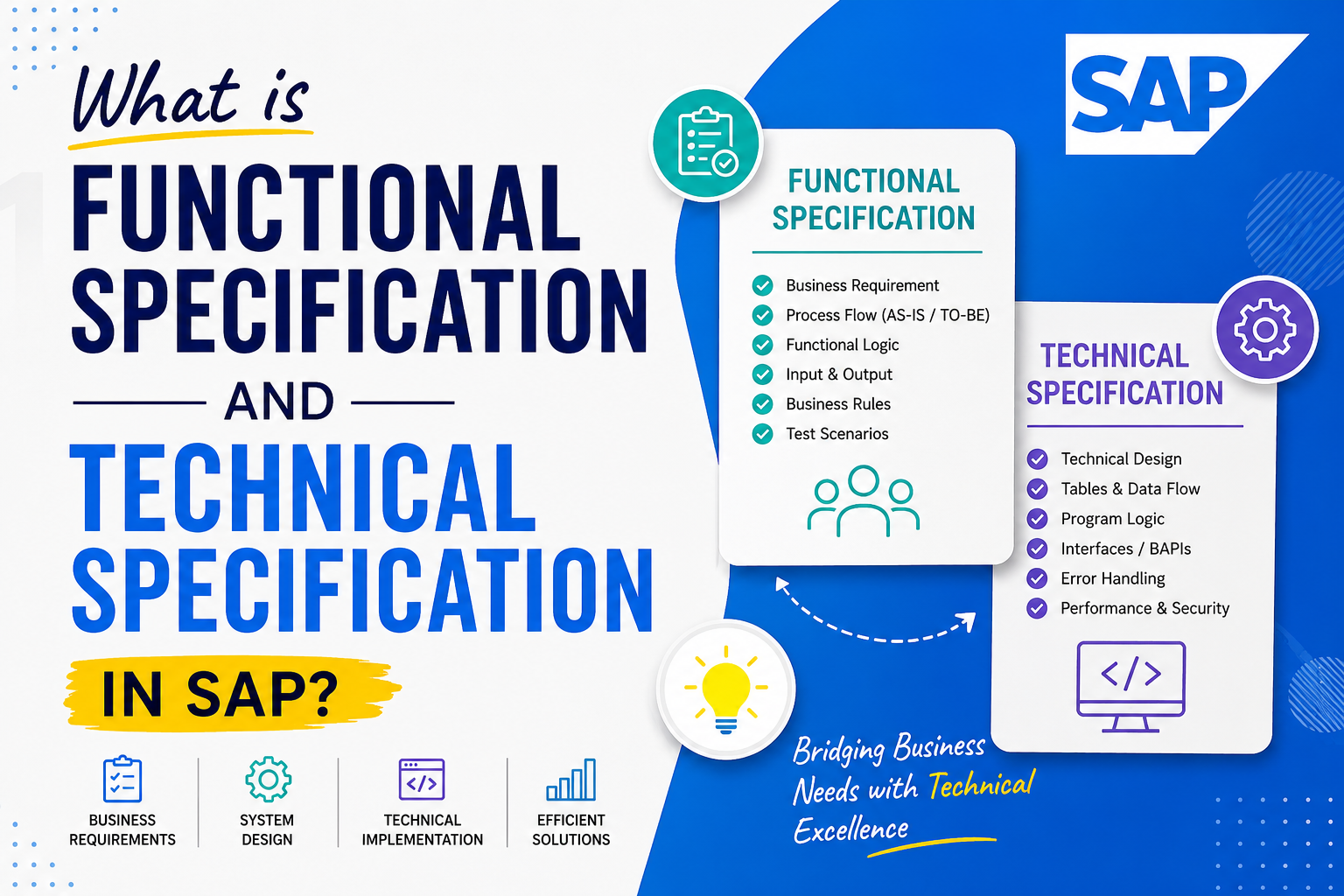
Functional and Technical Specifications are among the most important documents in any SAP implementation, support, rollout, or enhancement project. They act as a bridge between business requirements and technical development.
Whether you are an SAP FICO Consultant, MM Consultant, SD Consultant, or ABAP Developer, understanding these documents is essential for successful project delivery.
What is a Functional Specification (FS)?
A Functional Specification (FS) is a document prepared by a Functional Consultant that explains the business requirement and expected system behavior in detail.
It serves as an instruction document for the technical team (ABAP developers) to develop custom objects such as:
• Reports
• Enhancements
• Interfaces
• Forms
• Workflows
• Conversions
The Functional Specification focuses on:
✔ Business Requirement
✔ Current Process
✔ Proposed Solution
✔ Functional Logic
✔ Input and Output Requirements
✔ Business Rules
Why is Functional Specification Important?
The FS document helps:
• Convert business requirements into SAP solutions
• Reduce misunderstandings between functional and technical teams
• Ensure proper development
• Facilitate testing and user acceptance
• Maintain project documentation
Components of a Functional Specification
1. Document Information
• Document Name
• Version
• Prepared By
• Date
• Project Name
2. Business Requirement
This section explains why the development is required.
Example:
The finance department wants a custom vendor payment report showing:
• Vendor Number
• Vendor Name
• Invoice Number
• Payment Document
• Payment Date
• Payment Amount
3. Current Process (AS-IS)
Explains how the process currently works.
Example:
Users manually extract payment information from multiple SAP reports and consolidate it in Excel.
4. Proposed Process (TO-BE)
Explains how SAP should work after development.
Example:
A custom report should display all payment details in a single screen with export-to-Excel functionality.
5. Functional Logic
Defines business rules.
Example:
• Fetch payment documents from BKPF and BSEG.
• Display only cleared vendor invoices.
• Allow selection by Company Code and Posting Date.
6. Selection Screen Requirements
Input fields users will enter.
Example:
• Company Code
• Vendor Number
• Posting Date
• Document Number
7. Output Requirements
Expected report layout.
Vendor Invoice Payment Doc Amount
V1000 19000001 15000001 ₹10,000
8. Authorization Requirements
Defines who can access the development.
Example:
Only Finance users should execute the report.
9. Test Scenarios
Business test cases for validation.
What is a Technical Specification (TS)?
A Technical Specification is prepared by an ABAP Developer based on the Functional Specification.
It explains how the development will be technically implemented in SAP.
The TS document contains:
• Tables
• Programs
• Function Modules
• BAPIs
• Enhancements
• Data Flow
• Logic Design
Purpose of Technical Specification
The TS document helps developers understand:
• What objects to create
• Which SAP tables to use
• How data should be processed
• Technical architecture
Key Components of Technical Specification
1. Technical Overview
Description of development object.
Example:
Custom Vendor Payment Report – ZFI_VENDOR_PAYMENT
2. SAP Tables Used
Example:
Table Description
BKPF Accounting Document Header
BSEG Accounting Document Line Item
LFA1 Vendor Master
PAYR Payment Data
3. Program Logic
Example:
Step 1:
Read BKPF based on company code.
Step 2:
Fetch vendor line items from BSEG.
Step 3:
Join vendor details from LFA1.
Step 4:
Display ALV Report.
4. Selection Screen Design
Technical field definitions.
5. Error Handling
Example:
If no records found:
“Payment data not available.”
6. Performance Considerations
• Use indexed fields.
• Avoid nested loops.
• Use FOR ALL ENTRIES.
7. Security Requirements
Authorization object validation.
Difference Between Functional Specification and Technical Specification
Functional Specification Technical Specification
Prepared by Functional Consultant Prepared by ABAP Developer
Focuses on Business Requirement Focuses on Technical Design
Explains What is Needed Explains How it Will Be Built
Business Language Technical Language
Used by Developers Used by Technical Team
Functional Specification Interview Questions
1. What is a Functional Specification document?
A Functional Specification document explains business requirements and functional logic for custom SAP developments.
2. Who prepares the Functional Specification?
SAP Functional Consultants prepare the FS document.
3. What is the purpose of an FS document?
To communicate business requirements to the technical team.
4. What are the major sections of an FS document?
• Business Requirement
• Current Process
• Proposed Solution
• Functional Logic
• Input Fields
• Output Layout
• Test Scenarios
5. Why is functional logic important?
It defines how the system should behave according to business rules.
6. What is a TO-BE process?
The future business process after implementing the SAP solution.
7. What is an AS-IS process?
The current process followed by the business before enhancement.
8. How do you create a Functional Specification?
1. Gather requirement.
2. Analyze process.
3. Prepare business scenarios.
4. Define logic.
5. Design inputs and outputs.
6. Review with business users.
9. What information should be provided to ABAP developers?
• Business requirement
• Selection criteria
• Output format
• Validation rules
• Test scenarios
10. What is the role of UAT in FS?
To validate whether development meets business requirements.
Technical Specification Interview Questions
1. What is a Technical Specification?
A document explaining technical design and implementation details.
2. Who prepares the Technical Specification?
ABAP Developers.
3. What is included in a TS document?
• Tables
• Programs
• Logic Flow
• Enhancements
• Error Handling
• Performance Requirements
4. Why is TS required?
It serves as a blueprint for development.
5. What SAP tables are commonly used in FICO reports?
• BKPF
• BSEG
• BSIK
• BSAK
• BSID
• BSAD
• SKA1
• SKB1
6. What is an ALV report?
ABAP List Viewer used to display formatted report output.
7. What is a Functional Design Review?
A meeting where functional and technical teams validate the proposed solution.
8. What is a Technical Design Review?
A review of technical architecture and coding approach.
9. How do you ensure performance in ABAP developments?
• Proper indexing
• Efficient SELECT statements
• Avoid nested loops
• Use buffering where applicable
10. What is traceability between FS and TS?
Ensuring every business requirement in FS is addressed in TS and development.
Conclusion
Functional Specifications and Technical Specifications are the foundation of successful SAP projects. A well-prepared Functional Specification clearly communicates business requirements, while a detailed Technical Specification ensures accurate development and implementation.
For SAP Consultants, understanding both documents is crucial because they enable effective collaboration between business users and technical teams, resulting in high-quality SAP solutions that meet organizational requirements.
If you are learing or preparing for SAP Interview check out my consultant mastry packages.
1. SAP S4HANA FICO Consultant Mastry
https://topmate.io/bhagwat_bhokare/1988887
2. SAP S4HANA MM Consultant Mastry
https://topmate.io/bhagwat_bhokare/1867061
3. SAP S4HANA ABAP Consultant Mastry
https://topmate.io/bhagwat_bhokare/1867105
4. Other Important learning resources
https://topmate.io/bhagwat_bhokare
Author: Bhagwat Bhokare
SAP Techno-Functional Consultant | Trainer
Leave a Reply